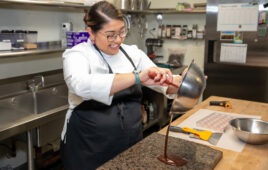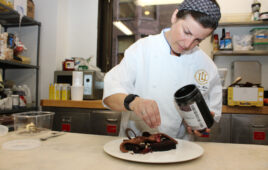
For Gerald Ford, CMC, sourdough baking is as much art as science. Here he offers a method for making your very own sourdough starter.
Sourdough is a treasured part of many bread programs. But where does the path to sourdough bread begin? The answer: with your own homemade sourdough starter.
Fermentation with natural yeast unlocks most of the nutrients trapped in wheat flour. This process makes for an utterly awesome bread experience. The flavor of your sourdough can provide the differentiation that your bread program may need.
In order to create your starter, you will need a week worth of patience, whole wheat flour, organic rye flour, filtered water, and a nice, warm space.
There is a bit of math involved in bread baking. Using bakers percentages, a sourdough starter has the potential of being used to make any variety of bread desired, from brioche to pita. The information provided here can serve as the foundation of your starter. Included are all the elements you’ll need, such as ratio, feeding, schedule, and a simple recipe for pizza dough.
I recommend always using organic, fresh milled flours. (It’s worth mentioning that my original starter was made with basic, AP store-bought blanched flour and organic rye. The texture of this recipe is akin to a Poolish.)
Every time you make bread, ensure you keep a percentage of the starter. For most formulas, I have developed the starter accounts for 40-50% of the final recipe. What the operation requires depends on individual research.
For the base sponge
100% Organic rye flour
100% Organic whole wheat bread flour (high gluten)
200% Filtered water (unfiltered tap water contains chlorine which inhibits yeast)
Whisk the flours into the water and put into a container that has plenty of room—the mixture triples in size. Place the base in a warm, dark area (85°-99°F) for two days. The first feeding should take place 48 hours later, the process is the same for all feedings, but the volume changes after the first feeding. I always use a scale for this process, put an empty bowl on the scale, zero it, pour in the starter, add the water, whisk it in and then stir in the flour.
Feeding 1
200% Starter
100% Organic whole wheat bread flour (high gluten)
100% Filtered Water
Return the base to the warm dark place and allow to ferment for another two days; the mix may smell very strongly of cheese, beer or bananas, don’t worry. These signs are typical. The mix requires a second feeding before it is ready for use in the kitchen.
Feeding 2 (and all subsequent feedings)
100% Starter
100% Organic whole wheat bread flour (high gluten)
100% Filtered Water
Allow the mixture to ferment for another 48 hours. Then, your starter is bread ready. The starter needs feedings every two days to be kept alive at room temperature. One of my favorite parts of the sourdough is the evolution and depth it develops over time. Every time I uncover my starter container, the smell generates instant joy.
Working with a bread starter helped me learn beyond the recipe and look deeper at using the ratio for creating delicious craft bread. Flours can be changed or modified. Ratios can be adjusted. Ultimately, the starter is a reminder to play with your food and experiment. Just remember: Never use all of the starter in a single recipe.
Sourdough Pizza Crust:
100% Starter
100% Bread Flour
50% 00 Farina
.25% Sea salt
1% Extra Virgin Olive oil
Water as needed to adjust consistency
Flour to handle
Procedure:
- Determine the final quantity of dough.
- Convert to bakers percentage.
- Scale the flours and the salt, mix.
- Scale and add the starter.
- Add olive oil.
- Knead until gluten is developed fully.
- Proof until doubled in size.
- Punch and scale.
- Shape and proof again or store under refrigeration until ready to use