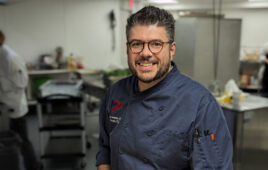

Kellen Gullatt, Executive Chef, The Lakes Country Club
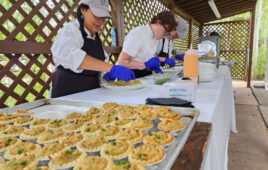
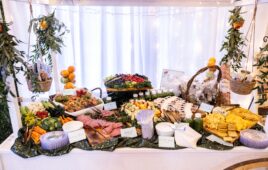
Banquet chefs have their hands full—literally. Whether planning event menus, sourcing ingredients, or executing orders for hundreds of covers in one sitting, the frenetic pace often threatens to upend itself. It’s no wonder culinary departments with their own banquet kitchens can convert chaos into calm, with dedicated space that allows the team to do their best work unencumbered.
Focused and Efficient
Boosting productivity in the kitchen is the mission of any culinary professional. For Executive Chef Kellen Gullatt at The Lakes Country Club in Palm Desert, Calif., this goal kicked into high gear when the club underwent a clubhouse-wide renovation in 2021 that included a new banquet kitchen—a necessity for the burgeoning events department.
“We could no longer operate banquets and a la carte services from the main kitchen alone,” explains Gullatt. “During peak season, we do roughly 18,000 to 20,000 covers with banquets and a la carte services combined.”
Given that he joined the club as Executive Sous Chef before taking on his current role three years later, Gullatt knew how fast-paced the kitchen could become any given weekend.
To better serve the newly redesigned banquet event center, along with the Lakes’ Santa Rose Room, private wine room and outdoor patio, a 3,000-square-foot banquet kitchen now houses two key areas. The back serves as the bakery and prep area, featuring large mixers, hot boxes, a vacuum sealer and other smaller equipment. The other side functions as the cooking and plating line, with convection ovens, combi ovens, a grill, a flat-top griddle, deep fryers, a steam table and plates.
Although the banquet kitchen stands apart from the 2,000-square-foot main kitchen, the two facilities share staff, with Gullatt relying heavily on two sous chefs who assist in banquets and a la carte dining, “each focusing more attention on one specific area. This helps ensure that we as a team are staying on course for various events and services while meeting all health department codes,” he says.
Having a dedicated prep and production space specifically for banquets has proven invaluable for Gullatt and his team. Not only has it improved organization and efficiency of the club’s culinary program, but having separate walk-in coolers, more space and equipment greatly benefits the overall flow. “It allows us to keep all food outlets open, whereas, in previous years, we would close a la carte dining due to large banquets,” he notes.
And while Gullatt is now responsible for a larger staff, a higher budget and a fully stocked second kitchen, he sees these as mere adjustments that outweigh any potential challenges. “So far, all the benefits of having a separate kitchen have negated any issues,” he adds.
Food for Thought
At The Cosmos Club in Washington, D.C., where nourishing the minds (and bodies) of academia is on the daily agenda, a banquet kitchen with optimal output is essential for feeding an active membership. Hosting approximately 80 lectures and events each month, this separate culinary facility has a production process that has been finetuned over the years, largely thanks to Executive Chef William Rogers, CEC, CCA.
Drawing from a storied career that includes a 10-year run at the Ritz-Carlton to five annual Masters tournaments, where he managed 2,000 daily covers, Rogers was up for the challenge of spearheading a kitchen renovation in 2017. “The last time was in 1983 when banquets were minimal,” he recalls. “We decided to split up the banquet side and wanted to stock it with the proper equipment and enough space.” With banquets accounting for $3 million in annual sales and $2.5 million for a la carte, they warrant the real estate.
The 2,000-square-foot banquet kitchen follows a square-shaped layout, each corner serving as specific prep/production zones.
“We have five tables on casters that we can move and integrate based on prep and plate-up time,” says Rogers. The walk-in cooler is near the dry goods rack, where common spices are stored. Over on the second wall is a prep table, including a sink and meat slicer, while the third zone houses dry storage for china, platters and bowls; a ripening rack for tomatoes, avocados, kiwi and other fruits; and hot boxes. Last but not least is the hot line, with a four-burner stove, kettle and combi oven. Rogers plugs the importance of small details, like five overhead outlets for spice grinder, blenders and other small equipment, as well as heat lamps that can be repositioned as needed.
Given the club’s mansion setting, where space is at a premium, Rogers focuses on optimizing output. “We buy only what we need to serve and don’t have a lot of excess,” he says. A rotating menu that concentrates on what’s in season helps simplify planning and sourcing ingredients. “We like to can, cure and ferment products and can use banquet space to store items,” he says.
Rogers and his team often look for ways to change up shelving, contemplating what drawers and containers can be purchased to stay organized.
“From time to time, my chefs and I will walk the space to see what’s working and what’s not,” he notes. Solutions that have proven useful include a common par shelf for dry storage items and a walk-in with common shelves for automatically restocked herbs. “This way, people aren’t hoarding their own salts, acids and oils; both teams can go there,” he explains. “Streamlining those pars has been great; it gives us the proper inventory, so we are not overproducing and reopening.”
Parallel Play
Culinary operations that are separate but equal require a deft hand and a willingness to adapt. At Druid Hills Golf Club in Atlanta, whose kitchen is under the helm of Executive Chef Brad Menhorn, both attributes are necessary for managing a la carte and banquet production.

Amassing a combined 1,800 square feet, the kitchen’s front half comprises an a la carte line—equipped with a kitchen display system (KDS)—while the back half has a traditional banquet line layout. “The parallel setup allows me to supervise and participate with both departments simultaneously, as I am an extremely hands-on chef,” says Menhorn, who has over 16 years of experience preparing banquets.
Although each side of the kitchen functions independently, Menhorn must balance various challenges, from coordinating product orders and staffing to handling peak hours for two busy entities. He stresses the importance of teamwork when faced with potential problems, emphasizing that a group-wide effort is the most effective solution. “‘Not my job’ is not a phrase we allow in the kitchen, as all jobs are equally important, and no job is below any of us,” he says.
Menhorn maintains a sense of order by being proactive to combat fatigue and avoid missteps. “We live and die by mise en place: Everything is in its place and prepared by our diligent early-morning crew before the sous begin to prepare,” he says. His team is now working on finetuning reaction time to last-minute order updates not only to meet but exceed expectations.
While Menhorn believes there’s no simple answer for pulling off a successful banquet, he affirms that preparation and execution are enhanced by a supervisor who leads by example.
“A leader tailors their approach to each situation,” he says, “making each order equally a unique challenge and an opportunity to learn how we can better serve our membership.”