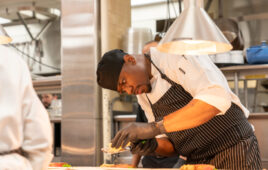
November marked year three of PlateCraft, a Chef to Chef Experience, hosted by Club + Resort Chef and Cullasaja Club (Executive Chef Scott Craig, WCMC, CCCD) in Highlands, N.C., with additional support from neighboring Highlands Country Club (Executive Chef Angel Herrera).
Like the annual Chef to Chef Conference (March 8-10, 2026 at The Broadmoor), PlateCraft is an event specifically dedicated to club and resort chefs’ continuous learning, but the experience for attendees of these events is vastly different. While Chef to Chef hosts hundreds, PlateCraft is an immersive, two-day workshop for a small group of about 25 club chefs from across the country who want to push their craft in a highly hands-on environment.
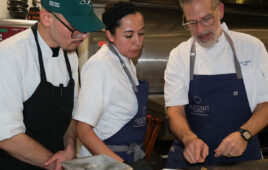
While last year’s PlateCraft centered around The Grand Buffet, this year’s event honed in on the Chef’s Table. Teams of attendees collaborated, cooked together, and created a chef’s table-style meal together with guidance from top culinary leaders: Cullasaja Club’s Craig; The Country Club of North Carolina’s Adam Deviney, CEC; Forsyth Country Club’s Lance Cook, WCMC, CCCD, WSET II; Mizner Country Club’s Daniel Montano, CECC; and Andy Chlebana, CMPC, instructor at Joliet Junior College.
At the end of day two, attendees were able to take a seat at the table to experience the meal as members would, tasting the results of their work, collaboration, and shared commitment to craft. The evening served as a celebration of process, precision, and the connection that happens when chefs get the opportunity to gather and create together.
As part of C+RC’s 2026 Cookbook, several of PlateCraft attendees—including Elijah, CEC, Executive Chef of Saddle & Cycle Club in Chicago—shared a recipe they found success with at a chef’s table at their own clubs, plus the inspiration behind the dish and why it works.
Club + Resort Chef (C+RC): Tell us about the inspiration for this dish/the circumstances surrounding the chef’s table.
Elijah Pulley (EP): The inspiration for this dish came about because I wanted to showcase my entire culinary journey on one plate. The dish itself gives several nods to my mentors and restaurants that allowed me to hone my craft. I often say that I have worked the gauntlet of restaurants, ranging from fine dining to BBQ all the way to Vietnamese takeout, and this dish really encompasses that entire journey. The Café du Monde tuile was a nod to my two greatest mentors, Chef Mark Hayes and Chef Garbin, both of whom introduced me to New Orleans food culture. The overall dish is a huge nod to the Mach Family who I worked for, for six years, and I owe a large amount of my success to them.
I presented a variation of this dish at one of my first chef-focused events at Columbia Yacht Club for the International Wine and Food Society. The goal was to give a statement piece. While all the dishes on the menu were great, I wanted them to understand where I came from as a chef and where I would be taking the culinary program. Being able to present them a “canvas” of my culinary career and talk about core individuals who helped shape me was crucial to laying the building blocks for what would become a very successful time at the club.
C+RC: What was R&D like? What were the biggest challenges?
EP: R&D for this dish was a lot of trial and error. One thing we wanted to avoid was having the smoke flavor become too predominant or for the dish to have an ‘identity crisis.’ We played around with the temperature of the smoke as well as the length until we were able to achieve the bark we were looking for. Each component of the dish has a strong flavor profile. Dialing each one in to ensure they complemented each other was a long process.
C+RC: Describe the flavors and presentation. What do you believe makes this a successful dish?
EP: The flavor profile of the dish is a balance of contrasting and complementary notes smoky, sweet, and salty, punctuated by bright citrus accents. This profile is achieved through layering that prevents any single flavor from becoming dominant.
The presentation is defined by its simple, intentional plating. Rather than relying on overly elaborate garnishes, the arrangement of ingredients is engineered for the member. Every element is carefully placed to ensure that each individual bite is guaranteed to deliver the full spectrum of the dish’s flavor profile.
This dish is successful because it achieves the difficult feat of bridging high technique with accessibility. It is a comforting, homey-style entrée that is built upon the foundation of Bò Kho (Vietnamese pot roast). By using this familiar and globally appreciated base, the dish is inherently approachable for members. Despite the hidden high level of technique required for its execution, the ultimate result is a dish that feels both elevated and deeply satisfying.
C+RC: What do you believe makes for a successful chef’s table experience?
EP: A successful chef’s table experience is measured by its lasting impact on the member. It needs to be more than a upscale dining experience. It is an intimate event designed to champion the culinary department, showcase the talent of the team members, and clearly demonstrate the elevated direction of the culinary program.
Central to this success is the art of restraint. While the chef’s table is an ideal format for creativity, it is crucial to balance innovation with member comfort. We need to ensure that the member is able to fully comprehend and connect with the dish before them, allowing for a dining experience that is both intellectually stimulating and deeply enjoyable. The goal is always to deliver exceptional culinary artistry while maintaining approachability and familiarity.