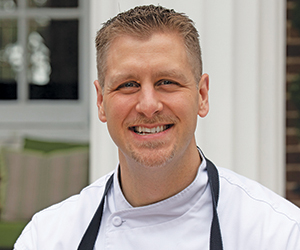
Gerald Ford, CMC, Contributing Chef Editor, offers six ideas to improve action stations.
Ten years ago, I realized something important. Sending my weakest cook out to work the buffet is not the right move.
It was a particularly busy July and we were in the middle of our wedding season at Westchester Country Club in Rye, N.Y. We had a series of action stations planned and, as usual, I was running around, working with each station chef to get ahead of the start of the cocktail hour.
We had pasta stations, several charcuterie tables, and a small, carved Porchetta for cocktail hour. I staffed these stations with my interns and least experienced cooks. At the beginning of the day, I thought this was the best plan, but by the end of that day, I swore I would never repeat the mistake.
As we move into a new era of buffets and action stations that will require more thoughtful service steps, here is what I’ve learned:
1. Use Seasoned Cooks on Action Station
The station chefs need to understand what he or she is serving. The carver on the porchetta knew I had eight roasts and I communicated that he needed 60 pieces per roast, but because of the lack of experience, the first fifteen slices made up half the roast.
There is a lot that can go wrong if you’re not paying attention. Often with significant events, there are many opportunities for failures, but by strategically placing strong culinarians in critical locations, problems can be solved before they spiral out of control.
2. Develop Flavor Before Setting the Station
Making flavorful herb purees, deeply concentrated sauces, and brightly flavored accompaniments make for interesting stations that leave mouths watering and bring members back for more. Mix seasonings into cheeses, infuse oils, use flavored salts and brine, or lightly cure proteins. All of these steps are done in advance and deepen the flavor of the food at the station.
3. Serve Hot Food or Cold Food
Warm/room temperature stations are fine, but interesting stations are closer to the temperature extremes. Food temperature is especially relevant, depending on the time of year. A game changer is having a plate warmer for the dishes that will serve the station. You want them warm, but not searing hot. I try to keep my plates at 120°F for buffets. Think about a Thanksgiving buffet and imagine the experience of hot gravy hitting a cold plate.
The same premise holds for cold dishes. Hold them in a cool box or the refrigerator. When I speak to my sous chefs, I always talk about 100° days and chilled gazpacho. In order for that soup to be cold by the time the member sits for lunch, the bowl must already be chilled.
Investing in quality hot or cold buffet equipment always improves satisfaction.
4. Convert à La Carte Favorites Into Stations for Member Events
Habitually, chefs take for granted that many of our dishes have a following. In some cases, the dish might not be all that interesting to us, but the members swoon for them. We can often make member satisfaction more complicated than it needs to be.
Transform the dishes that are tried and tested into action stations and watch how that station will be the talk of the next holiday event.
5. Choose Where Your Team Should Invest the Most Energy
I learned this lesson doing sliders.
There are many approaches to executing stations, but experience has taught me that a quality freshly cooked slider patty, fresh from the cooking source will rule most events. Everything I do revolves around serving that properly seasoned hot fresh, moist, patty at its perfect doneness.
I use a rich, high-fat roll, toasted in butter, and kept in a warmer, wrapped. Next, I use one sauce, exactly how I want it to taste, and one moist component, whether it’s a creamy slaw or melted Vidalia onions. Beyond that, I have an array of garnishes for members to choose from. All of my station chefs effort is put into cooking, seasoning, and serving that patty at my ideal.
6. Do the Basics Correctly
When I look to upgrade the quality of action stations, I start by examining our execution of the fundamentals of cooking. After that, I look at how that impacts the final result. Often, gimmicks, bells, or whistles are used to cover up a fundamentals deficiency. When the fundamentals get overlooked, mistakes are unavoidable.