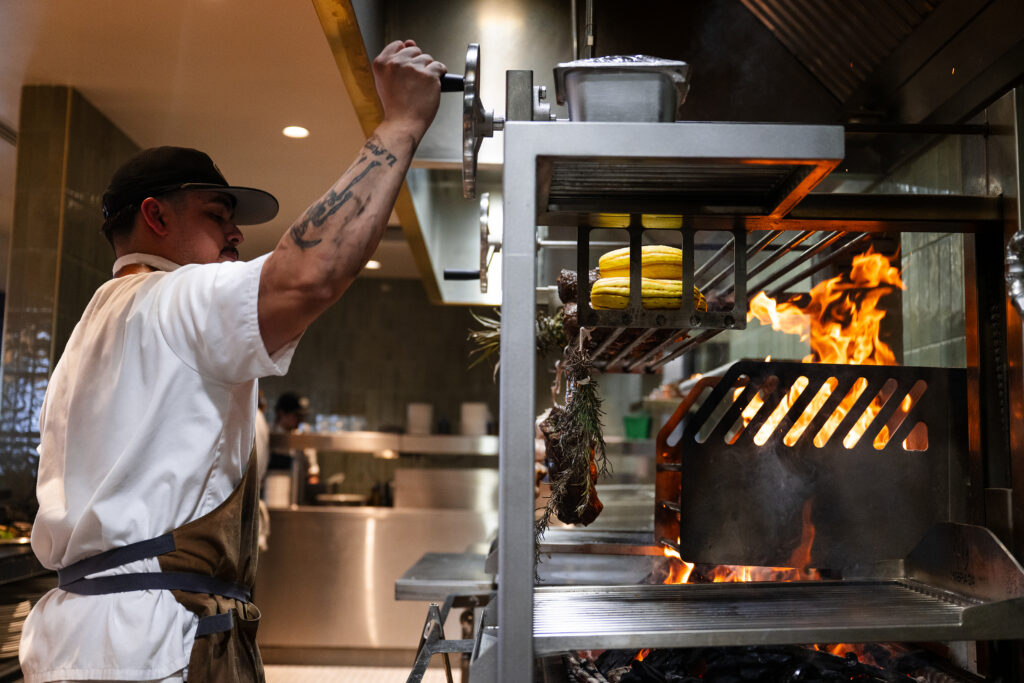
The kitchen at Colonial Country Club (Fort Worth, Texas) is heating up, thanks to a new live-fire grill that was recently added to the club’s Hawks Landing restaurant.
The adults-only, dinner-only concept with a bar, patio, and full dining room was designed around the live fire experience, making the grill part of the restaurant’s identity and atmosphere.
Executive Chef Cynthia Romstadt dives into the features of the new grill and how it’s transformed her team in the way they cook, collaborate, and operate.
Club + Resort Chef (CRC): Can you share a bit about what led you to your current role?
Cynthia Romstadt (CR): I’ve been at Colonial CC for four years and was promoted to Executive Chef in April 2023. Previously, as Executive Sous Chef, I led large-scale events, wine dinners, themed buffets, and interactive dining experiences. That background prepared me to oversee both daily operations and high-level programming across the club. Every plate that leaves my kitchen is guided by excellence, consistency, and purpose.
CRC: Walk us through the features of the new live-fire grill.
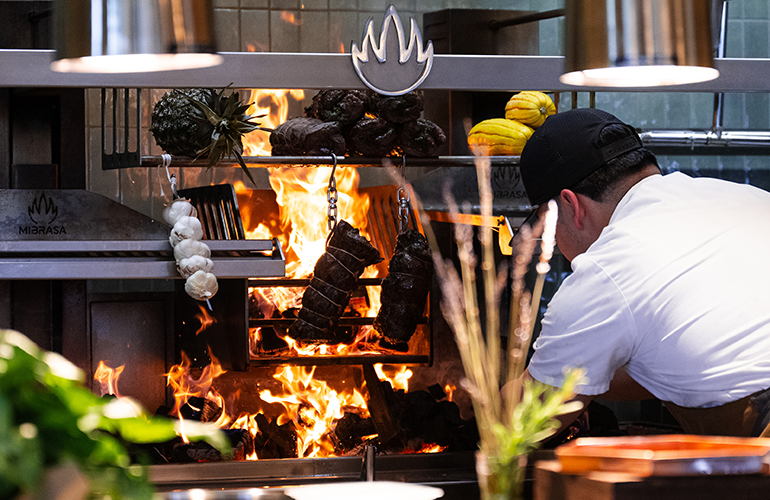
CR: What I love most about our live-fire grill is how it’s transformed the way my team cooks and collaborates. They work with both charcoal and firewood, creating steady coal heat layered with the unmistakable aroma that comes from burning wood. The adjustable-height grates are one of our most-used features. The sprocket-and-chain system allows smooth raising and lowering, giving precise temperature control during service. The fire basket lets us burn wood continuously and feed fresh embers as needed, keeping the heat steady.
The sloped grill design reduces flare ups and keeps things clean, while the refractory brick base holds heat efficiently and consistently.
What I enjoy most is watching them grow more confident cooking with their senses—reading the fire, adjusting height instinctively, and using live flame to bring out depth and character in every dish.
CRC: What led to the decision to invest in this grill: culinary vision, member demand, or operational need?
CR: It was driven by all three. Culinary-wise, it gives us depth of flavor and a clear identity. Members wanted a wood-fired experience and the visual component. Operationally, it provides defined heat zones and consistency at volume, which supports both daily service and marquee events.
CRC: You talk about transitioning to this grill required a shift in philosophies and logistics. What do you mean by that?
CR: Transitioning to this grill meant shifting both mindset and operations. Unlike a standard grill you can turn off and on, a live fire has to be lit, managed, and fed constantly. My team had to learn to cook by sight, sound, and intuition rather than relying on fixed temperatures.
We also rebuilt our logistics—creating fuel handling systems, adding a firetender role, and redesigning our prep and service flow around multiple heat zones. It completely changed how we think, train, and move as a kitchen.
CRC: What are the benefits of having a grill like this at a club? How do you frame live-fire cooking as a value driver in a private club environment?
CR: Live fire cooking brings a level of craftsmanship that really sets us apart. The open flame becomes part of the experience—members see the skill, the precision, and the artistry that goes into every dish. It helps us compete with similar concepts in our area because it feels elevated and authentic.
Plus, it’s a huge draw for talent. The best chefs and cooks want to work with real fire, refine their craft, and be a part of a kitchen that values technique, so it strengthens our recruiting and our culture.

CRC: What was the biggest learning curve when it came to using this grill?
CR: The radiant heat from the live fire grill is far more intense than what you get from a standard gas or electric unit. We learned quickly that the original 36 inches of space wasn’t nearly enough. In practice, we need about four to five feet of distance between the grill and the workspace.
Ash management became part of our daily rhythm. We pull spent embers into a safe container throughout service and build clear protocols for cooling and disposal.
Even though the sloped grill helps reduce grease buildup and keeps things cleaner, managing ash, cooling it properly, and moving it safely became a major operational rhythm we had to train into our workflow.
CRC: What operational challenges came with installing live-fire equipment on the third floor?
CR: The primary operational hurdle has been fuel transport—moving wood and charcoal up and down each day. Since all our fuel has to come up the elevator, we use a dedicated wood cart and run daily or weekly loads depending on volume. It’s a simple system, but it requires planning, rotation, and good communication.
CRC: You mentioned shifting from thermometers to “ear and eye.” How did you retrain your team?
CR: We still use thermometers, but we trained the team to rely equally on sight, sound, and feel. We ran three weeks of mock services so they could learn how the grill responds in real time. It was a major investment, but it accelerated confidence and control on the line.
CRC: What dishes have been transformed by live fire?
CR: Some of our biggest transformations have been in our salads and sides. The Grilled Little Gem has taken on this incredible smoky depth that you simply can’t get without live flame. Our ember-roasted beets develop a sweet, concentrated flavor from sitting directly in the coals, and the whole-roasted cauliflower becomes tender with a charred exterior that gives it a completely new character. Live fire turns simple vegetables into centerpiece dishes.
The signature Tomahawk is my favorite to make on this grill. The live fire gives it a depth of flavor you just can’t replicate.
CRC: What’s the biggest mistake chefs make when transitioning to wood/charcoal?
CR: Treating it like a standard grill. Live fire requires patience and control. If you rush it, put food over an active flame, or use wood that’s too wet, you end up with flare-ups, bitter smoke, or uneven heat. Beginners also underestimate how important it is to build a proper ember bed and let flames die down before cooking, which is essential for steady heat and clean flavor.
CRC: I saw on your LinkedIn that the club also invested in a new smoker. Walk me through its features.
CR: [Our] rotisserie smoker runs on 100% wood pellets with an automatic feed system that keeps temperatures steady. The IQ5 controller offers preset programs, and the convection fan ensures even heat distribution. It recovers heat quickly and handles high volume with consistent results.
CRC: How do these additions benefit your role and the overall membership experience?
CR: The mobility allows us to use it at tournaments, special events, and on-course activations. It supports daily production—smoked turkey, brunch prime rib, and signature items—while maintaining consistency and quality across the property.